Friday, April 15, 2011

Topaz Arts showcases work of artists with developmental disabilities


As published in the Times Ledger April 14, 2011

Original link

WOODSIDE -- A new exhibition featuring the work of artists with developmental disabilities will be on display at Topaz Arts in Woodside until May 1.

The exhibition, entitled “Sketchie: Sketchbooks & Artworks by Artists with Developmental Disabilities,” opened April 1 and features a collection of 12 personal sketchbooks, colorful pastel drawings and projected images of long-exposure photographs known as light paintings. About 20 artists with a wide range of developmental disabilities from AHRC New York City contributed the work, which they created during workshops at their nearby facilities.

Topaz founders and directors Paz Tanjuaquio and Todd Richmond chose to display “Sketchie” at their quiet space in Woodside because it offers a chance for New Yorkers to view the works of AHRC artists, which otherwise may go unnoticed by the community.

“Our focus at Topaz Arts is to present new works, from the emerging and established to under-recognized artists — showing works that have not been seen before and need to be seen in New York,” Tanjuaquio said.

Prolific art teacher Jason Cina said he led the series using a “back to basics” approach. He gave few parameters in guiding the student artists through each medium, so that the artistic sense of each individual would be displayed.

The artists used sketchbooks as a visual diary and means of problem-solving concepts, Cina said. As the themes progress, the sketchbooks become more rhythmic and cohesive with each page. Like any journal, some themes in the sketchbooks express personal thoughts on relationships and romance, while others display imaginative concepts and abstract shapes.

“Over time, patterns emerged — revealing details of the artists’ ability to translate visual information and more importantly, how they problem-solved and related objects in the space allotted,” Cina said. “To see their artworks and the way relationships or families of color are chosen and blended together in beautiful and intricate ways is awe-inspiring.”

Tanjuaquio and Richmond said they noticed a particular theme of artistic evolution in the sketchbooks and light paintings, which captured the essence of art in the making. “In the sketchbooks, the thought process can be imagined when viewing them. In the light paintings, the act of art-making is revealed and can really be felt and seen,” Tanjuaquio said.

Cina pointed out the detail in some of the sketchbook drawings, which required the artists to maintain focus and patience. Overall, the process of creating the art for “Sketchie” has had a positive effect on his students, some of whom are challenged with disabilities like autism and Down syndrome, he said.

Cina also said he noticed the high value students placed on art, with many opting to take his class instead of other workshops that offered a wage.

“The results are extremely positive all around. I have developed an almost Pied Piper following amongst the population, many of whom have natural artistic talent waiting to be nurtured, while others come for the company but still make as much of a concerted effort,” he said.

Admission to the exhibition is free. Topaz Arts is a nonprofit arts organization founded in 2000 by Richmond and Tanjuaquio, both artists, whose aim is to foster the creative process and offer affordable space to support the performing and visual arts.

The gallery is home to four exhibitions each year as well as dance performances. Tanjuaquio and Richmond enjoy showing the work of visual artists in painting, photography, installation, performance art, new media and sculpture.

Tuesday, March 29, 2011

Curtain to rise on Queens World Film Festival

Published March 3, 2011 in The Times Ledger

Original Link

The Queens World Film Festival kicks off Thursday, showcasing 109 films at two different locations in Jackson Heights.

Films will be shown Thursday through Monday at Jackson Heights Cinema and the Renaissance Charter School. The festival features films from all over the world, as well as some by local filmmakers.

Co-directors Don and Katha Cato said the mission of the festival is to identify overlooked and challenging films.

“Since the economic downturn, independent films are harder and harder to make, therefore it’s harder [for filmmakers] to get them screened,” said Don, a filmmaker who has been active on the festival circuit for decades. “In order to make their money back, the studios have to put a lot of money into advertising and marketing. Sometimes those costs are 10 times more than the cost to make the film. For that reason it’s become difficult to get these types of films screened.”

Don and Katha are both eager to showcase low-budget, quality films that have difficulty reaching an audience.

“We’re a startup, so we’re not going to attract $1.5 million movies. But we have some really good films that are independent low-budgets that really do strike a chord in terms of their ideas. They are all entertaining and compelling,” Don said.

Filmmakers submitted movies from Israel, Brazil, Taiwan, Canada, Oregon and Chicago, to name a few. About 15 films are from the New York area, with 10 of those from Queens.

Don and Katha estimate that about half the films that were submitted were selected for the festival. “We reached out to colleges, we made it as easy as possible for people to submit,” Katha said. “We also did a huge e-mail campaign. This is about doing something right, and a lot of people responded.”

The directors programmed the festival in blocks to maximize audience interest. There are 33 differently themed blocks, each one no more than two hours long. Some blocks are made up of a few short films, while other blocks show a single feature-length film. The block themes range from “Edgy Love Short Stack” to “Vampires, Zombies and Psychos.” At the end of each block, audience members have the chance to meet the filmmakers and partake in question-and-answer sessions.

A panel of judges, including Bill Woods, the New York coordinator for New Filmmakers Series; Jennifer Griffith, associate professor of music at Hofstra University; Stéphane Houy-Towner, a curator formerly with the Met; William Gadea, an animator who is creative director of Homebaked Films and teaches at the New York Film Academy; and Celested Balducci, a Queens filmmaker, will also hand out a number of awards at the end of the festival.

The winning films will be announced at the award ceremony on Sunday. Awards will be designated to the “Best Of…” winners in each category. Categories include “Best Narrative Feature” and “Best Narrative Short,” and more. There will also be honorable mentions as well as special awards, like “The Spirit of Queens” and “Best of the Festival” awards.

Sunday night’s ceremony will also feature a selection of work by the 2011 QWFF Youth Initiative. The program, spearheaded by Katha, allowed students at Our World Neighborhood Charter School in Astoria to create their own films. Some youths in the program will also be working at the festival.

Don and Katha said they’ve gotten incredible support from the community, but since the QWFF is only starting-up, they’ve had to pay out of pocket to make the event come together.

“Whatever it takes to make this thing happen, we’re doing it,” Don said.

Tickets are available for purchase online and at the screenings. Doors open at 6 p.m. on Thursday, opening night and tickets are a flat fee of $10. Opening night will feature remarks by Don and Katha, special guests, as well as two short films, one feature length film and a Q & A session.

On Friday, Saturday and Sunday the cost for seniors and kids 18 and under are $3 per block. For all others, tickets are $6 per block on those days. An unlimited festival pass is also available for $36.

There will be after-parties each night following the screenings. Visit www.queensworldfilmfestival.com for detailed information, including a full schedule and film information, as well as information on QWFF discounts at surrounding restaurants and hotels.

Mark Cuban Bets $5M on Future of 'Fingerprinting' Tech Devices

Published October 29, 2010 FoxBusiness.com


California-based startup BlueCava has locked in $5 million in funding from billionaires Mark Cuban and Tim Headington.
The Irvine-based company boasts of being the first startup to produce this level of device identification technology which works to prevent fraud during financial web transactions by taking a “fingerprint” of an electronic device. The technology also helps retailers reach potential customers via the Internet.

“We’re really quite unique in our position in this industry. We are the only company using this technology to improve online targeting,” said CEO David Norris.

As part of the funding, Cuban -- owner of the Dallas Mavericks basketball team and Landmark Theatres, and chairman of the cable network HDNet -- has joined the company’s board of directors, saying he sees “huge market opportunity” in BlueCava’s innovative technology. BlueCava says Cuban’s backing is a signal of many building blocks in the company’s future.

“Mark [Cuban] is a smart man who is passionate about technology,” Norris said. “He believes our business is very unique and he wants to help build it to its maximum potential and help us with our long term strategy of taking our business to a much larger size.”
Moving Forward by Backing Up The recent round of funding closed early because it was oversubscribed by nearly 500 percent, which left several investors waiting by the sidelines. That financial support is welcome security for BlueCava as they plan their expansion. Although the company’s marketing efforts are currently focused in the United States, Norris said they have long-term plans to expand into Europe and Asia.

In its most simple terms, BlueCava’s technology aims to specifically target online advertising and help prevent fraudulent activity. Retailers can use it to hone in on their target demographics by working with computing devices like iPads, smart phones, laptops, PCs or game consoles in any part of the world. Businesses can then detect, identify and track devices within their own environments.

And as a result of using the technology, BlueCava says online consumers can expect to see more relevant advertisements and less spam. And experts say an even bigger consumer benefit is in the patent’s fraud prevention potential, which protects against identity theft and the illegal re-distribution of content.

“Online fraud is at an all-time high as businesses are struggling with cost-effective and non-intrusive ways of reducing fraud,” said Souheil Badran, SVP and division manager of First Data eCommerce Solutions. “There is a need for device reputation data to be integrated into a merchant’s existing fraud payment, fraud identification and online advertising systems. Using the reputation information that BlueCava provides, firms can quickly and easily reduce fraudulent transactions.”

So, what about Big Brother? Norris said consumers should have no privacy concerns.

“We are big consumer advocates, especially when it comes to disclosure about things like trafficking,” Norris said. “We are doing significant things to make sure consumers understand that they can opt out. We support and endorse the ability for consumers to control their privacy.”

Trippingly on the Tongue

Jackson Rep opens its season with a performance of hip-hop/Shakespeare mashup 'The Sonnet Man'

Devon Glover

Published February 10, 2011 in The Times Ledger

(Original link)


The Jackson Repertory Theater is set to open its 2011 season in Jackson Heights with a performance of “The Sonnet Man,” an innovative blend of music and Shakespeare conceived by Broadway playwright Arje Shaw as a way of exposing young people to classical literature through a genre they know and love: hip-hop.

The concept for “The Sonnet Man” was dancing in Shaw’s head for 15 years before emerging into a long-anticipated reality last year.

Shaw’s vision was to successfully blend Shakespeare with hip-hop, and “The Sonnet Man” does just that. The group, which consists of rapper and lyricist Devon Glover, DJ Daniel Lynas and background vocalist Melissa Gutman, delivers a seamless fusion of hip-hop and Shakespearian sonnets, which are altered by a mixture of modern lyrics.

The balance of melodic beats and poetry draws a diverse audience that includes hip-hop lovers as well as Shakespearian aficionados. But perhaps the most powerful element of “The Sonnet Man” is the group’s ability to educate urban youth about classical literature through the fun and universal medium of music.

Brooklyn native Glover, 29, shines as the group’s frontman, along with the core group of Lynas and Gutman who performed with him on the self-titled debut album that was released last year.

On Jan. 6, Glover, Shaw and Guttman appeared on NBC’s “Today Show,” where they performed “Sonnet 18,” Glover’s favorite track from the album.

“I really wasn’t nervous about the performance. I feel like I was ready for it. But I was kind of nervous about the interview – I’m not used to interviews. It was surreal but a great feeling to be there,” Glover said.

Using music as an educational tool suits Glover, who currently works as an assistant after-school teacher and academic tutor. Whether it’s on stage or in the classroom, Glover’s main goal is to educate. He has one class to go before he earns undergraduate degrees in Mathematics and Education from Ithaca College.

“Whether I’m teaching Shakespeare or math, I just want to send a message,” Glover said. “The Sonnet Man” allows him to teach Shakespeare’s classic poems in a way that kids will more easily remember, because they are put to catchy beats.

The “Sonnet Man” songs are a collaborative effort. Glover, along with Shaw and Lynas, read through all of William Shakespeare’s 154 sonnet poems. They select sonnets that resonate with them on an emotional level, or carry a universal theme. Glover said he reads about 10 sonnets per day, looking for inspiration.

“The ones that speak to me when I’m reading them, they are the ones that I’ll want to record because they are heartfelt,” Glover said. After selecting a sonnet, Glover brings it to the rest of the creative team. Shaw, Lynas and Guttman help arrange the sonnet to instrumentation, and Glover colors it with fresh lyrics. “Everybody adds elements to the sonnets,” Glover said.

“We try to think of the mood [Shakespeare] was in when he wrote each sonnet. If it’s a feel-good mood, we’ll put it to a happy beat, and if it’s a somber mood, we’ll do a more bluesy song,” Glover said.

“The Sonnet Man” has been going strong since gaining national exposure on “Today.” They recently performed a cabaret-style set with a full band at Triad in Manhattan, and Glover said a second album is in the works, though a release date hasn’t been set.

The upcoming performance at the Jackson Repertory Theater falls on the weekend before Valentine’s Day, so Glover said they will focus on performing love-themed sonnets.

“Shakespeare wrote a lot about love, and its Valentine’s weekend, so it will be special,” Glover said, adding that he admires the Bard’s technique of writing “with his heart on his sleeve” — a phrase he coined, incidentally, in the play “Othello.”

“I think it’s going to be a wonderful event, so I really hope there are a lot of couples who will appreciate it,” Glover said. “This is not your typical hip-hop. It’s smooth. This is music that might draw people closer together for Valentine’s Day,”

Queens Museum brings collection of World's Fair photographer's work from Mexico

Published January 6, 2010 in The Times Ledger
The Queens Museum of Art is running an exhibition of the works of Luis Márquez, showcasing historic photographs and memorabilia from the New York World’s Fair that took place in Flushing Meadows Corona Park.

“Luis Márquez in the World of Tomorrow: Mexican Identity and the 1939-40 New York World’s Fair” will be on view through March 6.

The exhibition features an award-winning photographic account by Márquez, whose work highlighted folkloric Mexico with an eclectic range of photographic styles. The photographs were brought from the collections of Universidad Nacional de México and Universidad del Claustro de Sor Juana in Mexico City.

Most photographs were digitally reproduced from photographic negatives and are on display in the United States for the first time ever. There are also five vintage prints that were originally exhibited at the fair.

The photographic negatives were rediscovered by curators Itala Schmelz and Ernesto Peñaloza in the Luis Márquez photographic archive at the National Autonomous University of Mexico (UNAM) in Mexico City.

“This exhibition is the result of 10 years of research of almost 300 photos taken by Luis Márquez at the New York World’s Fair. They intrigued us so much that we asked ourselves how Márquez arrived at the fair and in what historical context he worked,” Schmelz and Peñaloza said in a statement through QMA.

Traditional Mexican folk costumes were also taken from the Mexican collections, to contextualize the folk-art element of Márquez’s work.

According to QMA Director of Exhibitions Hitomi Iwasaki, Schmelz put great efforts into gathering fair memorabilia to complement Márquez’s photographs.

“Itala came here to research the World’s Fair archives. She went to MoMa, The Museum of the City of New York and The New York Public Library,” Iwasaki said, adding that the memorabilia provides an interesting backdrop for Marquez’s work. The memorabilia includes newspaper clippings, advertisements, and interviews from the time of the fair.

“They wanted to bring [the photographs and memorabilia] back to the original location in New York as part of the bicentennial that took place,” Iwasaki said.

A good portion of the photographs at the exhibition involve images of sailors who were asked by Márquez to pose with models and folk dancers. Other photographs showcase the Mexican pavilion building, sculptures, fountains and general views. For his work, the fair awarded Márquez first place in its own photography contest.

Iwasaki said one of her favorite photographs at the exhibition is an untitled work from 1940 that shows a model posed in front of British pavilion, an exhibition print from original negative taken from the archive at the Universidad Nacional Autónoma de México.

Admission to the exhibition is by suggested donation of $5 for adults and $2.50 for seniors and children. Members and children under five are admitted for free.

With a critical eye

Favorites from the early years of movie critic Dave Kehr showcased at Moving Image in 'When Movies Mattered.'


Published Thursday March 24, 2011 in The Times Ledger


ASTORIA -- This weekend, The Museum of the Moving Image in Astoria will honor acclaimed film critic David Kehr with a program inspired by his recently published anthology, “When Movies Mattered: Reviews from a Transformative Decade.”

Published by the University of Chicago Press, the anthology features a collection of film reviews Kehr wrote between 1974 and 1986. It is the first anthology of Kehr’s work.

Moving Image is celebrating the book with the two-day program, entitled “Dave Kehr: When Movies Mattered,” which includes a personal appearance and book signing by Kehr and screenings of films by Raoul Walsh, Walter Hill, Luis Buñuel, Jonathan Demme and Jean-Luc Godard, all presented in 35 mm prints.
David Schwartz, chief film curator at the Moving Image, said that the films selected for screening have a special significance relating to Kehr’s writing.

“We wanted to choose a selection that was representative of the book, so we included some American directors who were emerging at the time,” said Schwartz

With a career spanning 40 years, Kehr was one of the first critics to write about American director Jonathan Demme’s early work, which is why Moving Image chose Demme’s 1980 film “Melvin and Howard.” Kehr’s book also contains reviews of the work of historic European directors, so film buffs shouldn’t be surprised at the selection of Godard’s “Every Man for Himself” (1980) and Buñuel’s “That Obscure Object of Desire” (1977).

The book also takes a look at movies from the early 20th century. To highlight that era, there will be a screening of a newly restored print of “Sailor’s Luck” (1933) by Raoul Walsh, one of Kehr’s favorite directors.

“American cinema is just full of undiscovered little gems like [“Sailor’s Luck”]. It’s exciting for me,” said Kehr, who described it as a film that was overlooked upon release.

“Sailor’s Luck” will open the series on Saturday at 2 p.m. Following the screening Schwartz will moderate a discussion with Kehr, along with audience Q & A.

Moving Image chose to highlight the publication of Kehr’s book because it demonstrates his place as one of the most important American film critics of our time, according to Schwartz, who acknowledged that much of Kehr’s earlier work may have gone unnoticed. He described Kehr’s early film reviews as brilliant, yet lacking exposure in New York, since he was writing for The Chicago Reader, a weekly newspaper.

“His work holds up next to the best film critics, it’s just that he didn’t have a New York platform,” Schwartz said. “This book will make this very important work available to New York audiences. Some people know him now from the New York Times because he’s their DVD columnist, but I don’t think they’re aware of his earlier work.”

The volume covers a vibrant period in filmmaking, when new movies were being made by the likes of Jean Renoir, Alfred Hitchcock, and Orson Welles; emerging New Hollywood directors like Walter Hill and John Carpenter, and international stars like Godard and Wim Wenders.

The reviews selected for the anthology were mainly selected by University of Chicago press editor, Rodney Powell, based on the simple conclusion that they would be of the most interest to readers.

“They are all kind of relics of a particular time,” Kehr said of the selections. “They tend to be longer — two to three thousand words. They’re examples of largely vanished popular criticism that I miss. I miss writing that kind of stuff, and I hope people enjoy reading them now.”

Modern media has changed tremendously since the publication of those reviews. The alternative press has been nearly wiped out by the Internet, a medium that favors short, concise synopsis, so there is not much room left for writers to truly indulge in a lengthy and thought-provoking critique of modern films. That, and films simply aren’t what they used to be.

“Movies today aren’t really the ones that lend themselves to that kind of lengthy discussion,” Kehr said. “It’s hard to have a lengthy discussion of something like ‘Hall Pass’ — the equivalent movie of the 1970’s would be ‘Animal House.’ Movies have changed.”

Kehr moved to The Chicago Tribune after leaving the Chicago Reader in 1986, and he was its principal film critic until late 1992, when he moved to New York to become a critic for The Daily News. In 2000, he took over the “At the Movies” column for the New York Times, and continues to write about film for the Times and other publications. Kehr also blogs at davekehr.com.

All screenings take place at the museum and are included with the price of museum admission.

Tuesday, November 30, 2010

Artist Profile - Sculpter Jon Kessler

Jon Kessler, Noriko, 1994. Plexiglas, aluminum, screenprint on cloth, duratran, mixed media with lights and motors, 47 x 31 x 26 inches

Sculpting with Light

As published by The Queens Times Ledger on Friday November 26, 2010
Original Link: http://www.yournabe.com/articles/2010/11/26/astoria_times/ent_news/at_ent_news_kessler_20101125.txt

LONG ISLAND CITY -- Jon Kessler, a New York artist who has become known in recent years for his anti-war installations, has mounted a career retrospective exhibit at the Fisher Landau Center for Art in Long Island City, with 12 pieces spanning nearly 20 years of sculptural objects made from a variety of media.


Among the pieces on display is “Iron Curtain” (1983), the first of his anti-war sculptures. The sculpture uses lights and motors to reveal the forms of plastic soldiers.

“Iron Curtain” is from my first show in New York in 1983, and ‘The Outsider’ is from 1999, and was the last piece that I exhibited before I made a big shift in my work and started making video sculptures,” Kessler said. “This work really does capsulate the idea of the early work of the ’80s and the ’90s.”

Kessler said he wanted to show these particular artworks because a lot of people are not familiar with his work from past decades. In recent years he has gained a whole new audience who were eager to make connections between his later works and his earlier works, he said.

“What was interesting about doing this show is that each one of those pieces really captured something I was going through. I could identify each one in a voyeuristic way,” Kessler said.

Some of the pieces on exhibit were made during a five-year period when Kessler lived in Paris. He said he does not have a favorite piece, but each one does capture very personal experiences Kessler was going through when he embarked upon their creation.

The curator of the exhibition, Nicholas Arbatsky, describes why these particular artworks are on display.

“I’ve known Jon’s work for 25 years and the first pieces I saw of his involved these [pieces on display]. It was a show at the museum of Contemporary Art in Chicago and there were computers and lights and army men flashing around the gallery, very similar to what he’s doing now. I thought way back to the show because it was lodged in my memory.”

Arbatsky said the exhibition shows how Kessler’s sculpture has evolved. “His sculpture has progressed from very basic beginnings with light and technology taking on more computer systems, almost taking on a minimal light balance, sculptural attitude.”

When viewers leave the exhibition, Kessler said he hopes they have gained an understanding of some of the ideas behind his work.

“I want them to be fascinated with the mechanisms and the poetry and the visual language. I’m hoping that they see connections in the works even though they do span more than 15 years of work,” Kessler said.

Philanthropist Emily Fisher Landau sponsored this exhibition through the Columbia MFA Thesis Program. The exhibition is free and open to the public and runs until Jan. 3.

If You Go
When: Monday to Friday, noon-5 p.m., through Jan. 3.
Where: Fisher Landau Center for Art, 38-27 30th St., Long Island City
Contact: Sydney Masters sydneymasters2@yahoo.com 718-937-0727
Web site: www.flcart.org

Thursday, September 23, 2010

Working on a Dream - Laurent Luke, R&B Artist Profile

As published in the Queens Times Ledger on Thursday, September 23, 2010
 
Original Link: http://www.yournabe.com/articles/2010/09/23/astoria_times/ent_news/at_ent_news_laurent_luke_20100923.txt
 

Twenty-one year old R&B singer Laurent Luke is revving up his career in the music industry. A fixture in the southeast Queens music scene who lives just over the Nassau border in Elmont, the up-and-coming songwriter describes himself as an urban gentleman hoping to reach people through his emotional, wholesome lyrics.

“I want to bring out love in my music. I write. A lot of people don’t get to write, so they don’t get to enhance what they say,” Luke said. “I bring out the emotion in my music. It’s about love — the mental aspect as well as the physical aspect.”

The Haitian-born musician came to the United States when he was 5 years old and grew up listening to artists like Boyz II Men, James Brown and the Jackson 5. He started writing love songs at an early age, picking up tidbits from the romantic relationships of his sisters and their friends.

After graduating from Elmont Memorial High School in 2007, Luke enrolled at Nassau Community College, where he currently studies business administration on a part-time basis.

In addition to his academic studies, Luke is getting an education in how to be a star, thanks to his managers, Steven Carthan and Carl Radjpaul, who have flung him into a militaristic “R&B Boot Camp.” Luke describes the regime as helpful and challenging.

The method involves surprising Luke with knocks at his door at dawn, accompanied by demands for on-the-spot performances. The boot camp also coaches Luke on how to interact with the public by hiring fake fans and reporters to swarm him after staged concerts.

“Steven and Carl are like my big brothers. They’re always making sure that my performance is better by putting me in a spot where I’m uncomfortable,” Luke said.

Luke came to meet his new managers by chance. He was out one night in January 2009, eating at the USA Diner in Rosedale. He overheard Carthan, who was at a nearby table, talking about his start-up production company, Start 2 Finish Productions and Publishing. Luke introduced himself, adding that he was a singer. That’s when Carthan challenged him to serenade the diner. His performance won them over, because shortly after, Luke and Carthan started working together, along with co-manager Carl Radjpaul.

Under their tutelage, Luke is developing a unique style to set himself apart from other artists. He describes the image he’s going for as “urban gentleman.”

“Wherever I go, I’m always respectable in my attire and what I say in my music,” Luke said. He wants to be prepared, because at any moment a big break could be just around the corner. “If they don’t get to speak to you, they see what you wear,” he said.

Luke is also seeking out bookings for performances in order to expand beyond modest-sized venues in Jamaica. He also has a collaboration underway with Red Spyder, a producer who has worked with Lauren Hill and Mary J. Blige. Luke and Spyder are set to release six songs together.

And songwriting is something Luke knows a thing or two about.

Every night of his freshman year at Nassau Community College, he wrote lyrics over all the instrumental samples he could find on YouTube. He compiled more 200 songs.

“I got to the point where I was eager to work and put out my music fast,” Luke said. “I had no money coming out of high school. So I went in my room and went through instrumentals and tracks. I went through seven months of just being in my room on YouTube writing, just writing.”

Since setting his sights on a music career, Luke’s attitude has been about self-improvement, about hard work, about discipline.

He says these efforts are ways to keep him growing. “I want to portray growth in everything I do.”

Wednesday, August 25, 2010

California's gay marriage ban continues until December


As published on The Examiner August 16, 2010


According to a court order issued late Monday, California’s ban on gay marriage will continue until at least December.

The decision came from a three judge panel of the Ninth Circuit U.S. court of Appeals. California’s gay marriage ban is remaining in effect until oral arguments are scheduled.

District Court Judge Vaughn Walker's ruling earlier this month invalidating the California law, known as Prop 8, was a huge victory for gay rights supporters. Monday's order puts that decision on hold but there's a clear indication from the Ninth Circuit that there may be a serious problem with the appeal.

The two page order directs Prop 8 supporters to address whether they hav the legal ability to challenge Judge Walker’s decision. The order states, “"In addition to any issues appellants wish to raise on appeal, appellants are directed to include in their opening brief a discussion of why this appeal should not be dismissed for lack of Article III standing,"

In December, the Ninth Circuit will have to determine if Prop 8 supporters will be harmed if Walker's ruling takes full effect, or to put it simply, will supporters be injured if homosexuals are allowed to marry. Supporters of the measure argue that California state law precedents give them the standing right to challenge Judge Walker’s decision.

Lawyers for the Prop 8 defenders argued in their brief to the Ninth Circuit that California courts have “repeatedly allowed proponents to intervene to defend initiatives they have sponsored.”

The lawyers representing the gay couples who are defending Judge Walker’s ruling point to a 1997 Supreme Court decision which casts “grave doubts” on the courtroom rights of ballot initiative supporters.

They claim that Prop 8 supporters lack standing to file an appeal and note that none of the state’s key lawmakers, like Governor Arnold Schwarzenegger or Attorney General Jerry brown, who normally have standing to file suit have done so.

Betel offering late-night menu inspired by Thai hawker food stalls

As published in The Examiner on August 24, 2010

Original link: http://www.examiner.com/ny-in-new-york/betel-offering-late-night-menu-inspired-by-thai-hawker-food-stalls

Betel Chef Adam Woodfield

West Village restaurant Betel, a modern Southeast Asian spot inspired by the Australian take on the hawker food stalls of Thailand, is launching a late-night menu Night Market.

The underground late night menu is inspired by the Asian night markets and is all about serving steamed buns. Starting at 11pm, when the kitchen is closed for dinner, Betel will be serving plates of buns to fix late night, post-cocktail carb cravings.

 And, just like the real night markets of the far East, patrons can test their luck haggling for the price of the buns. Order 3 and it might be $10, it might be free, depends how good the customer’s bargaining skills are.

Betel’s Night Market buns and drinks specials are available for a limited time, through October, from 11 pm until close, everyday. Haggling for buns is welcome every Monday night only.

 Chef Adam Woodfield is showcasing his favorite takes on late night food with his menu of Betel’s signature steamed buns:
  • Steamed Pork Belly Buns (3 for $10)
  • Steamed Wagyu Buns (3 for $15)
  • Steamed Curried Chicken Buns (3 for $10)

Enjoy these buns with drinks at happy hour prices – half price on all cocktails and beer, and select wines for $8 per glass.

Mixologist Mary Zayaruzny offers an extensive list of cocktails, all are made with fresh muddled fruit and seasonal ingredients. Betel’s most popular cocktails include:

  • Nashi Citrus Fizz (Three Olive Citrus Vodka, Prosecco, Naghi Pear, lemongrass syrup, lemongrass powder)
  • The Blackberry Passionfruit Caipiroska (42 Below Passionfriut Vodka, Lime, Blackberries, Palm Sugar)
  • Southeast Julep (Lucas Bols Genever, Crop Organic Cucumber Vodka, Cucumber, Vietnamese Mint, Lime, Palm Sugar).

A little about Betel:
After moving from Sydney to New York City in 2008 Chef Adam Woodfield (Public NYCand Jimmy Liks Sydney) and entrepreneur Luke Fryer sought to create an experience that is at once adventurous, fun and seductive. The Australian natives based their vision based upon the hawker food stalls of South East Asia mixing of bold flavors, elegant style and casual with Sydney’s own strong Thai food culture. The restaurant is named after the betel leaf, which is used in Asian cultures for its range of curative properties.

 *Betel is located at 51 Grove Street, between Bleecker St. and 7th Avenue.

Wednesday, July 14, 2010

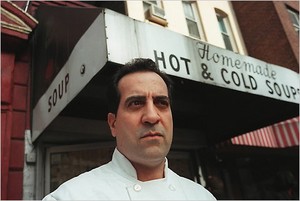
'Soup Nazi' to reopen Original SoupMan in Midtown

Michael Schmelling/Associated Press

By Morgan Rousseau
Published July 14, 2010 Examiner.com (original link)

NEW YORK CITY --- The original "Soup Nazi," Al Yeganeh, will reopen his Original SoupMan shop on 55th street. Yeganeh was made famous in Seinfeld's Soup Nazi episode, in which he was portrayed as a stern ladler of soup who would sometimes fly off the handle and shot, "no soup for you!"

The New York City soup legend opened for business in 1984, at Soup Kitchen International at 259A West 55th Street (between Broadway and 8th Avenue). In 2004, after his Seinfeld fame rocketed him as a food-culture icon, Yeganeh closed the storefront in pursuit of a nation-wide franchise.

His Original SoupMan brand and frozen soup production business were successful, but on July 20th, he will open his original location. According to the franchise website, all customers visiting the reopened location that day will receive a free T-shirt.

Representatives say the reopened location will still function under the franchise umbrella, but the soups will still be made from scratch, on the premises.

The original location will feature some new additions to the menu, such as asparagus caviar soup and Mexican tortilla soup.

Yeganeh has told media outlets that he plans to make sporadic appearances at the reopened location.

Become an original SoupFan by signing up on originalsoupman.com to order online and stay up-to-date on the menu choices. The site also includes rules for customers in 11 languages.

Thursday, July 8, 2010

New York to Allow No-Fault Divorce


By Morgan Rousseau
As published 7/9/2010 on The Examiner.Com (original link)

ALBANY -- New York is about to become the last state in the country to enact no-fault divorce, which means a spouse will not have to cite legal wrongdoing in order to obtain a divorce.

Governor David Paterson (D) is expected to sign the legislation into law soon. This coming 57 years after Oklahoma became the first state to allow no-fault divorce. Some view the benefit of no-fault divorce is in the speediness and simplicity of the process.

As of now, married couples must cite legal misconduct, like adultery, or endure a court-sanctioned one-year separation agreement if they want a legal divorce.

But if Paterson signs the legislation, and supporters are optimistic he will, one party in a marriage can end their union at any time, for any reason.

Those opposed say that no-fault may raise New York’s annual divorce rate, which stands at a low three percent. Others are concerned that the legislation could hurt the spouse with the least income, typically the woman.

Prominent women’s activist Marcia Papas, who runs the National Organization for Women in New York state, told amNY that “women will have to spend more to prove they deserve damages and make it easier for men to walk out for capricious reasons.”

The Catholic Church stands opposed to no fault divorce, saying it sends the message that marriage is a “disposable institution.”

Still, supporters say disputes between couples seeking a divorce will be minimized, as spouses split on irreconcilable differences rather than assigning fault.

Wednesday, July 7, 2010

Growing Rate of Senior-Aged STDs: Viagra, Healthy Life to Blame

By Morgan Rousseau
Published July 7, 2010

Orginal link to Examiner.com

A new report says the rate of sexually transmitted diseases in older men taking erectile dysfunctions drugs like Viagra is twice as high as men not taking the medications. But doctors say that for men in both groups, the number of STDs is soaring higher than ever before.


According to the Centers for Disease Control and Prevention, there were more than six new cases of STDs per 10,000 men over 40 years of age in 2008, which is up almost 50 percent since 1996.

Younger adults still have far more STDs than older adults, but the numbers are growing at a far higher rate in elders. The reason for this development is not yet understood, but more divorces and better health may be contributing to a boost in sexual activity among older people.

The issue of unprotected sex is obviously a problem for senior-aged people who are not accustomed to using condoms. Researchers say that 50-year olds are six times less likely to use a condom than men in their 20s.

Dr. Anupam B. Jena of Massachusetts General Hospital in Boston told Reuters, “We are typically unaccustomed to practice safe sex over the age of 50, because the risk of pregnancy is eliminated.”


Wednesday, June 23, 2010

Zikrayat Releases 2nd Album, Blends Modern with Classic Egyptian Music


By Morgan Rousseau

As published on Thursday, May 6, 2010 in the Queens Times Ledger
 
LONG ISLAND CITY -- Zikrayat, the Queens-based musical group that performs new sounds inspired by the golden age of Arabic music and dance, released “Cinematic,” its second album, Saturday. The release was a long-anticipated follow-up to the 2008 Independent Music Award winning album Live at Lotus.

Bandleader Sami Abu Shumays, a Long Island City resident, composed original music for the album, mixing it with both popular and rare songs and dance instrumentals from Egyptian film musicals of the 1950s and 1960s. The arrangements evoke the sound of mid-20th century Egyptian film orchestras.

According to Shumays, Zikrayat strives to capture the Egyptian small ensemble referred to as “takht” and also capture the texture of the musicals.

“They have a lot of dance music. It’s fun, but it’s sophisticated. We capture that kind of artsy-retro dance,” Shumays said.

Shumays plays violin and also sings backing vocals for Zikrayat. The vocals of Salah Rajab are highlighted by the dance beats of master percussionist Faisal Zedan on “Cinematic,” which also features percussionist Johnny Farraj, oud and accordion player Dimitri Mikelis, nay player Bridget Robbins and bassist Apostolos Sideris.

“Cinematic” is a mix of studio tracks and a few live tracks that capture the sounds of their inspired performances.

“We have this whole variety show inspired by the vaudeville format because we can present different sides — the more classical end as well as dance elements, all in one show,” Shumays said.

Joining Zikrayat in their upcoming performances are musicians Tareq Abboush (buzuq, backing vocals), Salma Habib (vocalist), Rami el-Aasser (percussion) and Zafer Tawil (percussion, oud, violin and backing vocals), and belly dancers Robin “Dameshe” Shumays (Sami’s wife, and Zikrayat’s dance director), Yowalka, Mariyah, Sherine and Jaida.

Zikrayat is set to perform its variety show at the LaGuardia Performing Arts Center Friday at 8 p.m., in a multimedia production featuring clips from Egyptian films of the 1940s through the 1960s synchronized to live performances of dance and vocal numbers. The event will feature master dance artist and choreographer Dalia Carella, who will pay tribute to dancer Badia Masabni’s Casino Opera and other Cairo night-clubs of the 1920s and 1930s.

Their LPAC performance promises solo dance pieces alternating with solo vocal pieces, group dance pieces, a vocal duet, instrumental improvisations and more. The show is part of LPAC’s Lab program, which looks to give exposure to emerging artists in New York City.

“What I find exciting about Zikrayat is their ability to address many different audiences across different disciplines,” said Steven Hitt, LPAC’s managing director.

The music and visual performance put on by Zikrayat speak to the Arab and Arab-American community in New York.

“We have an audience of Arabs and Arab-Americans. The younger people have an interest in exploring the culture, while the older people have a nostalgic connection to it,” Shumays said.

However, the music also aims to catch the interest of the belly dance community – which encompasses a multitude of cultures and social groups.

“The belly dance audience is not very familiar with the depth of the tradition, but it is poppy and fun,” Shumays said. “It has an appeal to both audiences.”

The vision for Zikrayat began after Shumays and his wife Robin returned from their honeymoon in Egypt in 2005. The couple purchased a variety of old Egyptian musicals, and promptly fell in love with the genre. After pitching the concept of the group to a few musical acquaintances, Zikrayat was born.

Shumays describes the time period they are exploring as “very ornamented and intricate.”

“My wife’s a belly dancer, and she likes stuff from the ’60s, ’70s, ’80s — upbeat music. We reached a point of agreement with the ’50s,” Shumays said. “It’s a period where Cairo was producing many musicals per year. It still had this very complex sensibility regarding melodies, but it was also fun, upbeat and danceable.”

Zikrayat will also join Salma Habib at Joe’s Pub in Manhattan May 23 at 9:30 p.m. Habib is a prominent up-and-coming Arab vocalist in the United States.

“Cinematic” was introduced with a performance by Zikrayat Saturday at Barbes in Brooklyn, where there were also performances by musical groups Shusmo and Falu. There was a simultaneous broadcast on WFMU 91.1 FM on Rob Weisberg’s “Transpacific Sound Paradise” show, which can be streamed from WFMU’s Web site at wfmu.org/playlists/shows/35624.

The album is available for purchase at zikrayatmusic.com and CDBaby.com and on iTunes, and is also available during Zikrayat’s live performances.

Original link: http://www.yournabe.com/articles/2010/05/06/queens_village_times/ent_news/qv_ent_news_zikrayat_cinematic_20100506.txt

Live at the Gantries brings music to LIC waterfront

By Morgan Rousseau

As published on Friday, June 11, 2010 in the Queens Times Ledger
 
QUEENS -- The 2010 season of Long Island City’s performance series Live at the Gantries is kicking off with a sunset show at Gantry Plaza State Park June 13 with a performance by the Long Island City Jazz Alliance, a new collective formed by jazz fans and musicians that live and work in LIC.


Live at the Gantries is a series of 10 outdoor free shows featuring some of Queens’ most celebrated new entertainers. After Sunday’s show the performances run weekly, every Tuesday, from June 22 through Aug 18 at 7 p.m. at Gantry Plaza on the Long Island City waterfront.

The series offers up a diverse selection of music, ranging from jazz to classical, power gospel to rock ‘n’ roll and more.

The series is organized and produced by The New York State Office of Parks, Recreation and Historic Preservation, Queens Theatre in the Park, and Queens Council on the Arts. All three organizations work together, each contributing resources and commitment to make Live at the Gantries what it is.

Since Live at the Gantries began in 2008, it has drawn an eclectic audience of all ages — a combination of LIC residents and folks from other Queens neighborhoods and boroughs, thanks to a blazing word of mouth.

Rachel Gordon, regional director at the Parks Department, came up with the idea for the series because she wanted to make the most of a beautiful state park in the Queens community. “[The series] brings a wonderful sense of community in the larger sense. Not just a community within a few blocks, but in all of Queens, for the city as a whole,” she said.

Gordon calls Live at the Gantries a “unique series in a unique park that stresses the diversity of Queens.”

She describes the selection of performers as a broad spectrum of diversity. “There is a marvelous array of music, performers and people from different parts of Queens, and people from different parts of the world that come to Queens,” Gordon said.

Chris Henderson has been curator of Live at the Gantries for the past three years. He describes the event as having a relaxed setting with a family-oriented crowd made up of children and young adults. In order to choose the musicians, Henderson assembles a master list of Queens-based musicians from which the performers are chosen.

“I’ve worked around the borough, so I know a lot of the bands in the area. I give [the organizers] a list of the bands. We then collaborate on the right mix of balancing different kinds of music — things that are obscure, things that are popular,” Henderson said.

Jeff Rosenstock, executive director of Queens Theatre in the Park, says the organization has been involved since its inception three years ago. Rosenstock says Queens Theatre in the Park’s goal is to make something unique and “Queens-oriented” happen in LIC at no charge to the community.

“We see Live at the Gantries as a window into the artistic depth of our borough’s emerging and diverse performing artists, as well as an entry into one of the city’s most beautiful locations — Gantry Park,” Rosenstock said.

This year’s line-up includes Opera Collective (June 22), whose name is self-explanatory; Pass Kontrol (June 29), an art collective and band that puts on plays and musical performances; Jia-Yi He (July 6), a Taiwanese harmonica virtuoso; DB Rielly (July 13), a roots musician; Mundoclave (July 20), an Afro-Cuban jazz act; Andy Statman (July 27), a mandolin-and-clarinet maestro; the St. Paul AME Mass Church Choir (Aug. 3); Hiromi Suda (Aug. 10), a classically trained singer who has taken up Brazillian jazz; and a closing performance by Mission: on Mars (Aug. 17), an Indian-flavored fusion band.

Adrienne Patino of Opera Collective says the musical group strives to make opera accessible to the general public, which makes Live at the Gantries a perfect venue.

“Any organization like Live at the Gantries that provides musical experiences to the public is very appealing, and you couldn’t ask for a better setting than our city skyline,” Patino said.

Three out of the 10 members of Opera Collective live in Queens. “Being a rather new Queens resident myself, I love getting to know my borough. This series will allow me to explore more parts of my community. And we strive to make our communities better through music,” Patino said.

Gantry Plaza State Park is a 2.5 acre waterside spot between 49th and 50th avenues along the East River in LIC. The venue offers a perfect view of a skyline sunset, with open seating.

"Our goal was not to re-create another large scale outdoor summer festival, but rather to take some exceptional Queens-based artists, fuse them with a beautiful setting and share it all at no charge with all who wish to attend,” Rosenstock said.

Live at the Gantries is sponsored by TF Cornerstone, Rockrose Development Corp. with additional support from State Assemblywoman Catherine Nolan, City Councilman Jimmy Van Bramer, L Haus, O’Connor Capital Partners and Con Edison.

For more information visit www.liveatthegantries.com.


Original Link: http://www.yournabe.com/articles/2010/06/11/queens_village_times/arts/qv_arts_live_at_the_gantries_20100610.txt

Make Music NY Stretches to Queens Neighborhoods

Outdoor music fest expands its reach in Queens


By Morgan Rousseau


As published on Thursday, June 17, 2010 in the Queens Times Ledger

QUEENS -- Hundreds of additional acts are slated to perform at a number of new outdoor, public venues in Queens and across the city at this year’s edition of the celebrated musical event Make Music New York.

Last year’s MMNY had more than 800 events across all five boroughs. This year’s MMNY, set to take place June 21, promises about 5,000 musicians of all ages and musical persuasions — from hip-hop to opera, Latin jazz to punk rock and more. The performances will take place on New York’s streets, sidewalks, stoops, plazas, cemeteries, parks and gardens.

Thousands of musical performers, amateur and professional alike, are expected to perform an elaborate and diverse array of tunes for passers-by.

The musical event, now in its fourth year takes place simultaneously with similar festivities in more than 300 cities around the world, based on France’s Fête de la Musique, a lively street music festival held every June in Paris.

This year’s MMNY has spread to bustling but less central neighborhoods of the city, such as Astoria, Harlem, Fort Greene, and DUMBO. Each of these neighborhoods has benefited from volunteer organizers who helped connect musicians with performance locations.

Astoria Park will welcome jazz and rock performances between the hours of 4:30 and 8 p.m., and Athens Triangle in Astoria will offer a venue for rock and world music from 1-8 p.m. Other Queens locations to host music include Brick Café in Astoria, Gantry Plaza State Park in Long Island City, Queensbridge Park in LIC, Espresso 77 in Jackson Heights, and Tower Square Starbucks in Woodside.

Founder Aaron Friedman says he modeled MMNY after Fête, which he saw in 2006 while in Paris.

“I wanted to give New Yorkers a chance to interact with each other in a spontaneous, musical way, and learn about different kinds of musical cultures in this very diverse city,” Friedman said.

Friedman said this year offers new presenters and highly anticipated performers.

“The first year had 560 free, outdoor concerts across New York City. This year, we’ll have over 1,000 concerts, with about 5,000 musicians. Not only has the event grown, but we’ve started a number of innovative projects,” Friedman said.

One such project will take place in Central Park, where MMNY will offer a celebration of the music of visionary Greek composer Iannis Xenakis. Funded by the Stavros Niarchos Foundation, the festivities will include a percussion performance of Xenakis’ “Persephassa” (1969). Xenakis’ music will be performed by six percussionists surrounding the lake.

The Celebration of Xenakis features two different percussion groups – one at the Naumburg Bandshell and the other will be dispersed around Central Park Lake. Three percussionists are slated to perform on the western shore. Audience members are invited to listen from row boats, as there will also be percussionists performing on floating stages. In addition, the composer’s sole opera “Oresteia” will be performed in Central Park’s Swedish Cottage Marionette Theater in a puppet production directed by Italian choreographer Luca Veggetti.

Other notable performances around the city include a New Orleans-style second line jazz parade that will work its way from Soho to Lincoln Square and uptown to Harlem; a program of interactive electronic performances in the Meatpacking District; the Play Hard Corporate Challenge, which gives a performance outlet to business executives who are also amateur musicians; Mass Appeal, which brings together hundreds of musicians to give mass performances onf pieces written for single types of instruments, including accordions, drums, gongs, iPhones, trumpets and tubas; and Punk Island, with more than 100 of the city’s loudest bands playing on Governors Island, where there are no decibel restrictions.

Mayor Michael Bloomberg said in a statement that the event is a great example of why New York City is one of the world’s cultural capitals.

“Make Music New York gives residents and visitors a chance to experience the City’s diverse musical riches in their own backyards or explore the sights and sounds of other neighborhoods,” he said.

For a complete schedule and list of locations, visit www.makemusicny.org.

http://www.yournabe.com/articles/2010/06/17/queens_village_times/arts/qv_arts_mmny_2010_20100617.txt

Thursday, April 15, 2010

Astoria's Santos pays tribute to Brazilian roots on CD

As published in the Queens Times Ledger, Thursday April 15, 2010
By Morgan Rousseau


Adriano Santos always knew he would play drums. He recollects being drawn to the instrument at 5 years old, pressing his face against store windows and perching beside the stages of local restaurants offering live music in his native Brazil. Now, decades later, Santos asserts with confidence that he couldn’t be happier than he is now — living in Astoria, performing in Manhattan, and recording with some of jazz’s most notable musicians.


Santos’ new release, “In Session,” pays tribute to Brazilian composers who are not well -nown here in the States.

“I decided to record tunes that made an impact on my talent as a musician and tribute to the drummers that play with composers,” Santos said. The album features tributes to musicians like Brazilian jazz drummer and percussionist Airto Moreira and composers Moacir Santos, Toninho Horta and Milton Nascimento.

Although Santos has contributed to numerous recordings with prominent musicians, “In Session” is his first recording as a band leader. Santos says the members of his quintet hold prestigious spots in modern music scene. The album features Helio Alves (piano) David Binney (alto sax) Dende (percussion) and David Ambrosio (AC bass).

Santos said it was refreshing to take charge of his musical output after being a sideman for so long. “It’s a process you go through in New York,” he said. “I realized for the 15 years I’ve been here that I was so busy working with other people and learning material for other musicians that I never had time to stop and do my own stuff ... In 2008 I had a little break from gigs and tours, so I said, ‘Maybe it’s time for me to do my stuff and not wait for the phone to ring.’” That’s when he began putting together the repertoire and choosing the musicians for “In Session.”

But the Brazilian composers featured on the album were not the only musical influence shaping Santos.

“Having two older brothers was a great thing, because they listened to a lot of different styles of music. We’d listen to a variety of pop and instrumental music,” Santos said of his time as a child in Brazil. “We’d go to clubs that would play videos from the U.S. and England. I used to talk about how one day I’d be playing live music like that.”

He began his drum studies at Zimbo Trio Music School in Brazil, also known as CLAM, at the age of 12. In 1988 he brought his Brazilian musical influence to the United States when he enrolled at Boston’s acclaimed Berklee School of Music.

“I never turned back. I loved it, the whole vibe at Berklee. There was music all day long,” Santos said.

After earning his bachelor’s degree in Film Scoring, Santos came to New York to attend the City College of New York’s master’s program. It was there that he enjoyed ensemble lessons with jazz legend Ron Carter.

“I think it was the right move [coming to New York]. As soon as I got here, I was the only Brazilian drummer that could read music at that time. That was a big plus for me,” Santos said.

Shortly after settling in New York, Santos started getting gigs outside the college. He thrived on watching other Brazilian performers in the city.

“New York is good because you get to see such great musicians all the time. When you go out at night, you are always learning something new.”

Santos has produced publications in specialized drum magazines and released a new book through Drummers Collective NYC, where he is also part of the faculty. The book is entitled “Afro-Caribbean & Brazilian Rhythms for Drum Set.”

As for future recording endeavors, Santos asserts that a studio album is on its way — this time featuring his own original compositions.

Astoria is now home to Santos, who originally moved to the neighborhood in 1996. After relocating to Manhattan, and then Brooklyn, Santos happily settled back into the eclectic rhythms of Astoria. It’s been nine years.

“I love it,” Santos said. “The vibe, the atmosphere, the culture and, of course, all the Brazilian restaurants.”

“In Session” is available for purchase on CDbaby.com, iTunes, Digstation.com, Amazon.com, and adrianosantos.com.


Original source: http://www.yournabe.com/articles/2010/04/15/astoria_times/arts/at_arts_adriano_santos_20100415.txt

Friday, February 12, 2010

A Sit Down With Saget

By Morgan Rousseau


Talking to Bob Saget, it’s hard to believe you are not sitting there with his former TV alter-ego, Danny Tanner. That is, until he drops the F-bomb.

Saget has battled the clean-cut, single father image of the ABC family sitcom “Full House” since it first aired in 1987. On top of that, Saget’s corny humor on “America’s Funniest Home Videos” branded him as a wholesome family comedian. But after bidding adieu to both shows, Saget exposed the darker side of his comedic talents - raunchy humor.

In an interview with the Collegian prior to his performance at Curry Hicks Cage Friday night, Saget opened up about his long-standing career in comedy, and where he's found himself now.

“Stand-up gives you a rush like nothing else. It’s nothing but fun,” said Saget, adding that he feels at home with a college audience.

“I think that’s one of the reasons people like me, because I appreciate that we have great, amazing young people,” said Saget.
Saget’s risqué style of humor was perhaps best depicted in the 2005 film “The Aristrocrats,” in which he tells the infamous dirty joke of the same name. He admits the joke is so risky that when he tells it at stand-up shows he usually loses 90 percent of laughs in the room. Needless to say, he told it Friday night.

“It depends on the audience. If I look down from the stage and see a 10-year-old kid sitting there, I’m going to clean it up a little bit. I mean, I won’t start talking about his mom’s t***ies, because...well, because he shouldn’t be having thoughts like that about his mom, anyway.”

But going out on a limb is what fills the seats, particularly if it’s a college-aged audience. College venues are now his forte, or so his tour schedule says. He was right at home with the depraved humor of the average male college student who has daily doses of “Family Guy” and “Opie and Anthony.”

This might account for why his stand-up act“This Ain’t Full House” sold out the Curry Hicks Cage on Friday night, and packed hordes of excited students. All chanting his name, of course.

As the scene of enthused pandemonium radiated through the Cage and into Saget’s backstage trailer, the comedian could only sit back and say, “I’d love to go out drinking with everyone here tonight, but I don’t want to get half the campus pregnant. It’s a joke.”

Young adults eat up a chance to hear a 50-year-old Danny Tanner -who we thought we knew so well - spewing a rainbow of profanity and talking about Uncle Jesse’s pubic hair, or lack there of.

Somewhere in the middle of his act, Saget grabbed a guitar and toyed around with it, swearing like a belligerent teenager. He was just too excited to be up there, it seemed, because his act was all over the place. He would start a story that wouldn’t draw to a close for another 40 minutes, or so. Tangents were a-plenty Friday night, and Saget was dishing them out like a caffeinated line cook. He intermittently named off some of the Internet’s most heinous adult Web sites; this was where male humor took over.

The manner of his stand-up is simple: swear constantly, be blunt and to the point, but most of all, remain confident. Anyone can try it and fail miserably, but Saget knows he is Bob Saget, and he is confident in every sense of the word. As we all saw Friday night, it is hard to stop a man who thinks he is The Man. I

Friday’s stand-up routine also consisted of UMass students screaming to Saget, and him playing off of it with a friendly yet offensive response. Combine that with rancid jokes as dirty as they come. As his set grew to a close, clusters of obnoxious girls rushed the stage, rambling incoherently and pleading for Saget hugs - but considering his cracks about college-aged girls, he must have enjoyed it.

Saget says he didn’t decide to be a comedian at a young age. Originally he was interested in filmmaking.

“When I was eight, my dad, who was a butcher, gave me an eight millimeter camera, and I played around with it,” Saget said. “I made all the cliché effects and showed them off. It was like “America’s Funniest Home Videos.”

He went on to study film at Temple University, where he won a Student Academy Award for a documentary he made in 1977 titled “Through Adam’s Eyes.” After college Saget went to work at the Comedy Store in Los Angeles, where he met some of the most successful comedians in history, including Rodney Dangerfield, Richard Pryor and Robin Williams.

“I was interested in acting but never thought I’d be good,” said Saget. “But I worked for free six years at The Comedy Store, and got to meet and become friends with some of the best comedians.”

In the 1980s the comedian turned to acting, and because of the popularity of his stand-up he gained roles in television shows, like “Bossum Buddies.” He also had a small role in Richard Pryor’s 1987 movie, “Critical Condition.”

“I’d land small roles in television shows, but at the end I’d be edited out, and the credits would still say ‘guest Bob Saget’ at the end,” Saget said.

But it’s the role in “Full House” as Danny Tanner that made the difference in his career. Saget said it was just a matter of good timing that he was cast on the hit show. He didn’t expect the show to run eight years.

With his success in “Full House,” ABC offered him the role of the host of “America’s Funniest Home Videos” and Saget accepted. Starring in both shows made him the first person in television history to have two top rated shows in the same week.

Since leaving his role as the host of “Home Videos” and the close of “Full House,” Saget has remained busy with directing, playing small roles in movies and doing stand-up. He has also tried having his own show again called “Raising Dad,” but it only lasted one season. Now Saget is in the process of developing his Web site, http://www.thebobsaget.com/.

Look for him later this fall, as he will be returning to television as host of NBC’s new game show “1 vs. 100.”

“The show has been on Europe, but now we are bringing it to America. It’s kind of like ‘Hollywood Squares’ but its one person answering against 100,” he said. “It’s Hollywood squares with diarrhea.”

As published in The Massachusetts Daily Collegian

NYC Band Looks East for Inspiration

Consider The Source Slams NYC with Ethnic Fusion
By Morgan Rousseau


They consider it “Progressive Ethno-Fusion,” while others would call it ideal late-night entertainment for the college aged youth of New York City. The eclecticism reflected in their music is ever-present in New York, from the Turkish corner store to the Indian restaurant a few blocks away. Consider The Source is a band that appreciates the layers of cultural dimensions that make up their city. Thanks to their relentless dedication and independent promotion, CTS plans to make this their year to shine.

On Nov. 10 at The Village Underground on West Third St. guitarist Gabriel Marin, a tall young man with classic rock star shoulder length blonde hair, shows off a distinctive style of playing his fretless guitar – hunched over and eyes closed, clearly lost in a musical realm of his own making. A Hunter College alum, Gabriel, 25, hails from the Upper West Side in Manhattan, but met fellow band mates and Queens natives John Ferrara and Justin Ahiyon, both 24, through a heavy rock circuit of musicians when they were in their mid-teens.

Bassist John and drummer Justin, both Queens College alumni and Oakland Garden natives, perform with a mesmerizing ability to raise your heart rate with steady, growing energetic rhythms. Justin’s vigorous drumming combined with a hot, cramped venue like The Village Underground prompts him to go shirtless mid-set. They are hard to miss, even through the smoky air of the tiny club. Sweaty and furiously thrashing, something in their music still manages to come across as serene. Most likely it’s the Eastern tint in their musical style.

Something all three of these young men have in common, though, is their down-to-earth modesty. They smile and hug members of the audience when their set ends. They even hit up near-by bars, inviting everyone in attendance to tear it up with a late night after party. Their amicable reverence for each other is nearly tangible. These guys share an unspoken relationship for each other, thanks to their music.

“We’ve become friends through the music. The three of us have a unique style on our instruments,” Gabriel said in reflection of the band’s roots. CTS began at a party one night about three years ago when Gabriel and Justin started jamming together. “He was the only other person that was into Turkish music,” said Gabriel. Soon after they brought John into the mix.

What culminated was, as Justin put it, “a dynamic connection in music,” so the musicians decided to make it official. They named their band, started recording their improvisations and booked venues.

Their use of Indian and Mid-Eastern musical style comes straight from the source – in January 2006 Gabriel and Justin traveled to India in search of authentic lessons in life and the exotic music of the land. They proudly announced on their homepage, considerthemusic.com that “we're traveling across the globe with our instruments, in pursuit of music and inspiration.” According to Gabriel, “The trip didn’t change our style as much as it reconfirmed that it was the direction we wanted to go in.”

While in India the pair crashed with the musical Gurus they were studying under in Calcutta, and at other times stayed in cockroach ridden youth hostiles. They were completely submerged in the poverty and chaos of the city, but took it as a learning experience. After a thirty-three hour journey to the South, they were pleased to stay in a decent apartment with other percussion students. They opened their minds, and tuned into the teachings of the East in the hope of brining a newfound strength to their music.

And so they did, only to return to the U.S with a deeper connection to the music of the Far East, and a spirituality that beckoned them to explore the idea of genre bending.

According to Gabriel, this aspect of their music includes Bulgarian folk tunes, Jewish folk music, Northern and Southern Indian classical music, Persian music, Turkish music and American jazz and heavy metal undertones. “We all grew up playing jazz, and I was really into classical, too,” Gabriel said. “[The fusion] comes from the metal, jazz and classical music in our blood. We were a fusion band for a year and a half before we went.

John picked up on his band mates’ enthusiasm for the sound right away. “It’s rhythmic, and in-depth. Once it was exposed, we had to explore it,” he said.

Justin described Indo-Eastern music as having the ability to “make you leave yourself,” like a vehicle for spiritual transportation. Once they started applying this aspect to their improvisational jamming, the two sounds of East and West just fell together.

With no lead singer, the band compensates for their absence of vocals with the sporadic insertion of one-liners from an electronic sampler, mostly in the form of quotations from the movie “Borat.” CTS said they are inspired by movies, and enjoy having a sense of humor when they perform because it lightens up their performance, and gets a kick out of the crowd. John said that the band is an instrumental trio that has no problem taking risks with their audience. He said that their strong instrumentation works for them because they have open-minded fans that produce what Justin considers “an atmosphere of love.”

“They are throwing love at us, and it inspires us to give it back,” he said, with a sudden surge of excitement. Justin then went on to describe the key ingredient to their crowd stimulating ability – he and his band mates thrive on the energy of the audience during live performances. Justin feels that fans may be disappointed with their studio albums after experiencing the invigoration of high-energy music at their live sets. Their studio album doesn’t quite capture that lively, improvisational peak that defines their live set. The band agrees that their albums may be more subdued and less captivating than their live performances, so the band’s next album will be recorded during a live New York show set for Feb. 2008, date to be announced. At the present time the band is focusing on promotion and publicity, and in turn they are taking a breath from booking many upcoming shows. Their next performance will be on Dec. 18 in Philadelphia, but they announce new shows on their Myspace Music site, http://www.myspace.com/considerthemusic, or considerthemusic.com where their two albums, Esperanto (2006) and Consider The Source (2005), can also be purchased.

As published in the Queens Times Ledger

Tool Shakes The Stage

The Tweeter Center Awakens With a Darker Art


By Morgan Rousseau

Their live performance is an emotional experience that channels our anger, excitement, inspiration and fear. And still, after a five year hiatus, Tool is still known for the exceptional quality of their live performance. On Friday the Tweeter Center in Mansfield welcomed Tool, along with thousands of their patient fans.

Most of the audience went wild with ferocity at the first instance of the band’s presence on stage. They started the show with “Stinkfist,” one of their comparatively better known songs from the album Aenima.”
The stage wasn’t embellished with decór, and neither was the band. Vocalist Maynard James Keenan, who has sported over the top costuming in past shows, replaced black body paint and leather briefs with an orange windbreaker and jeans. Regardless of the simple scenery, Tool still managed to engage the audience in an intense experience fueled by stellar music.
Shortly into “Aenima,” aesthetics found their way into the show. Although many venues offer large screens behind the stage, The Tweeter Center offers no such thing - so visual stimulation wasn’t too prevalent. But there were a few things to liven up the visual aspect of the show.
Thanks to two tiny screens on each side of the stage, the crowd watched the uniquely unsettling “claymation” film-art done by Tool’s guitarist, Adam Jones. Above the crowd tufts of smoke interrupted blue and green laser beams.
Although the band opened with one of their older songs, most of their set consisted of new songs from their album, “10,000 Days.”
After “Aenima,” they took it down a notch with “The Pot,” only to spike everyone’s adrenaline again by playing “Forty-Six & 2,” followed by “Jambi.”
The audience’s reaction showed a clear distinction between their old and new songs. Although their new songs were well enjoyed - their old ones were celebrated in the crowd. It was then that hair went flying in chaotic directions, and fists boxed the air.
The middle of their set consisted of the songs, “Schism,” “10000 Days,” “Rosetta Stone,” “Wings for Marie” and “Lost Keys.” But the highlight was yet to come.
A good performance knows how to simulate the ultimate performance - sex. Tool’s set had a deliberate arrangement designed to bring the audience higher and higher with excitement; but just before reaching the peak of satisfaction, they lowered us down to catch our breath. In between longer energetic songs the band soothed their crowd with their usual instrumental breaks, which are similar to what they do on their albums.

“Lateralus” delivered the climax. Anyone who is a fan of any solid musician or band knows what this means - complete satisfaction. A complete release shared by everyone within the radius of the performance.
Next, they played “Vicarious,” their first single from “10000 Days.” After that Keenan gave the words, “Peace the f*ck out.” But as confused fans waited in angst for something more than the band’s departure, the venue filled with the unmistakable grunting chants of “Ʈema.”
Tool has always done a good job of keeping their music as the center point, and separating themselves from the spotlight. This show was no different as the four band members maintained their exact places on stage
Their set lasted a mere two hours, which seemed short, but also understandable considering the Tweeter Centers’ 11 p.m. curfew.
After the show, like any other Tool performance, there is a feeling of relief and relaxation. Their musical delivery is an emotional and interactive release of many ferocious feelings.
While their music isn’t as aggressive as it used to be, it’s almost as stimulating. Their new songs are more political, whereas their earlier songs were more emotional, sexually aggressive and philosophical. Though still dark and heavy, their sound is not as hard or “thrashy.”
The band has often praised their fans for listening and respecting Tool as artists, and listening with their hearts. The fact that the band can take a lengthy break, and still have thousands waiting for them when they come back to the stage says a lot about their fan base’s dedication.
The band has withheld the test of time since their first release, “Opiate,” (EP) in 1992. Since then the band has released five more albums; “Undertow” (1993) “Aenima” (1996) “Salival” (2000) “Lateralus” (2001) and most recently “10000 Days” (2006).
All four members of the band gave remarkable performances; drummer Danny Carey produces hypnotic percussions, Adam Jones is mesmerizing on electric guitar, while Justin Chancellor delivers magnetic bass lines. And Maynard is a musical poet of exception. If you haven’t witnessed him stomping his leather bound boots in the dark corner of a morbidly lit stage, you should.
As published in The Massachusetts Daily Collegian